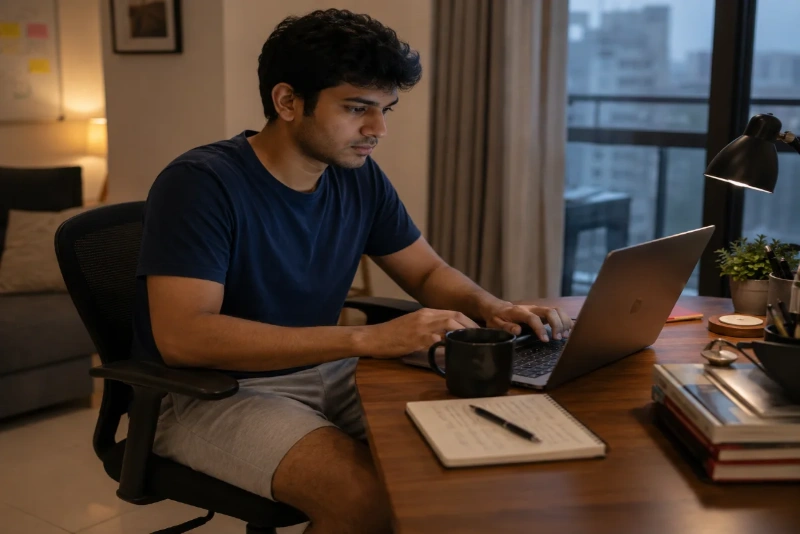
The first thing Vikrant said in Monday's standup was not good morning. It was, "Can everyone switch cameras on, please?" Twelve people reached for the same button with the same tiny pause. Some were in office chairs. Some were at dining tables. One person was clearly sitting on the edge of a bed because the Wi-Fi was better near the window. Nobody objected. They had objected before, and it had not helped.
Vikrant managed a product operations team in Gurgaon for a mid-sized fintech company. By most accounts, he was not a terrible manager. He knew the product, remembered deadlines, and did not throw people under the bus in leadership reviews. But he had one belief that had hardened into policy: every internal call needed cameras on.
Not client calls. Not quarterly presentations. Every call. Daily standups, backlog grooming, quick syncs, Friday evening escalations, and the especially unpopular 9 AM Monday meeting that often began while half the team was still negotiating with breakfast, traffic noise, school buses, doorbells, and broadband mood swings.
The team had tried the normal route. They had raised camera fatigue during retrospectives. They had explained that remote work did not mean every domestic corner needed to become an office backdrop. They had pointed out that some calls were short, some were purely operational, and some involved people who were listening while also handling real life at the edges of the workday. Vikrant listened, nodded, and returned to the same sentence: cameras help us stay present.
So the team decided to become present. Very present.
"We stopped arguing with the rule. We followed it so completely that the rule had to explain itself."
This account is based on a workplace story shared with DilRoyal by a member of a hybrid team in Gurgaon. Names and identifying details have been changed. The details were reviewed with two managers who have run distributed teams, because the issue underneath the joke is real: remote-work rules often fail when they are written for control instead of usefulness.
The Three-Week Camera Experiment
The plan began as a joke in the team's unofficial WhatsApp group, the one that had been created months earlier for lunch orders, release panic, and the kind of feedback no one wanted to put in Jira. Someone wrote, "Fine. Cameras on means cameras on." By Sunday night, the joke had become a quiet agreement. No one would refuse. No one would complain. They would simply obey the rule with unusual enthusiasm.
Why It Worked
The team did not win because they were clever, though they were. They won because the experiment made the cost of the policy visible to the person enforcing it. Before that, the burden belonged mostly to the team. They had to arrange rooms, manage family interruptions, stay visually available, and absorb the discomfort of being watched during calls that did not need faces. Vikrant only saw a neat grid of compliance.
Perfect compliance changed the view. Once everyone followed the rule all the time, the rule produced all its side effects in public. Calls became visually noisy. Short meetings felt heavier than they needed to. People who had been efficient with cameras off were now spending energy managing posture, lighting, and background movement. Vikrant had not intended any of that, but intention did not erase impact.
A remote-work rule should solve a real work problem. If the rule exists mainly to reassure a manager that people are paying attention, it will usually create theatre instead of trust.
There is a phrase people use for this kind of response: malicious compliance. But in this case, the word malicious feels too harsh. The team did not sabotage work. They did not mock Vikrant in the meeting. They did not embarrass him in front of leadership. They complied in a way that exposed the rule's weakness without creating a formal conflict. That is why it worked.
The Better Camera Policy
The revised policy was not anti-camera. That matters. Cameras can be useful. They help with first meetings, sensitive conversations, workshops, conflict resolution, and moments where facial cues reduce confusion. The team's complaint was never that cameras were evil. The complaint was that cameras had become a blanket proof-of-work mechanism.
Good remote teams tend to use a lighter rule: default to the format that serves the meeting. A five-minute status update can be audio. A design review may need screens more than faces. A difficult one-on-one may benefit from cameras if both people are comfortable. A client presentation probably needs visual presence. The point is judgment, not ritual.
Do not ask for cameras as a substitute for trust. Define when cameras help the work, explain the reason, and leave room for people to turn them off when the meeting does not need visual attention. Measure outcomes, clarity, and follow-through before you measure faces on a screen.
What the Team Learned About Feedback
The funny part of the story is easy to enjoy. The more useful part is quieter. The team had already given feedback directly, and it had not landed. The experiment worked because it turned an abstract complaint into a lived experience for the manager. That should make managers slightly uncomfortable. If employees have to perform a rule's failure before leaders understand it, the feedback system is not healthy.
Vikrant, to his credit, did something many managers do not. He changed his mind without making the team pay for proving the point. He did not hunt for the person who started the plan. He did not frame the discussion as disobedience. He recognized that the policy was causing friction and adjusted it. That is why people on the team still speak about him with more affection than resentment.
How Remote Workers Responded
Vikrant still manages the team. Cameras still come on, but now they come on for a reason. Standups are shorter. Friday syncs are rarer. The unofficial WhatsApp group still exists, because every team has one whether leadership admits it or not.
The difference is that the group has less to complain about. Sometimes that is the most practical measure of a policy change.
"A camera can show a face. It cannot prove focus, trust, or good management. Those still have to be earned."