It rained the kind of rain that shuts down a city for three days straight, the kind where the local news starts using the word "unprecedented" by day two and everyone's WhatsApp groups fill up with videos of cars half-submerged near the underpass. Riya lives forty minutes from the office on a good day. Those three days, the commute took her two hours, then two hours and twenty minutes, then almost two and a half, because the autorickshaw she'd booked on the third morning simply refused to go through a particular stretch of water and she had to get out and walk the last fifteen minutes in shoes that were never going to be the same again.
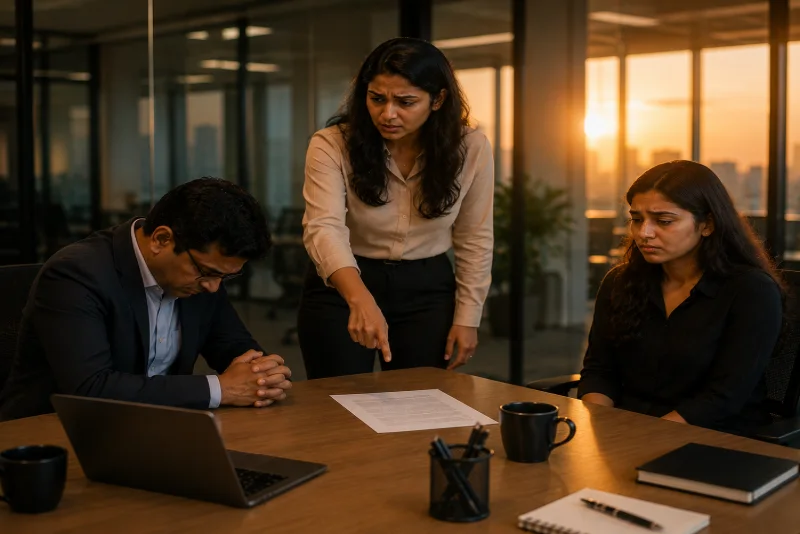
She walked in each of those three mornings somewhere between forty and sixty minutes late. She messaged her manager, Vivek, before she left home each time, and again when she got stuck, and again when she finally reached her desk, soaked, apologetic, already opening her laptop before she'd even sat down properly. On the fourth day, the rain stopped. Riya was on time. Vivek called her into a small meeting room anyway and told her HR would be setting up a Performance Improvement Plan.
She thought, for a genuine few seconds, that she'd misheard him.
"He said punctuality was a 'foundational expectation' and that three days in one week was a pattern, not an excuse. I remember thinking — a pattern of what? It rained. That's not a pattern, that's a Tuesday in this city in June."
The Conversation That Wasn't Really a Conversation
What stayed with Riya longer than the PIP itself, oddly, was how little room there'd been in that meeting to actually explain anything. She'd tried, in the first thirty seconds, to walk Vivek through the specifics — the flooded underpass, the autorickshaw, the messages she'd sent each morning that he'd seen and, as far as she could tell, never replied to with anything beyond a thumbs-up emoji. He'd cut her off, not rudely exactly, but firmly, the way someone cuts you off when they've already decided the meeting's purpose before you walked in. "I understand it rained," he said. "But other people on this team made it in. I need to know you can be relied on regardless of the weather."
Other people on the team, as it later came out, lived closer, or worked from areas the flooding hadn't touched as badly, or in one case had simply stayed at a relative's place near the office for those three nights specifically because they'd seen the forecast. Riya hadn't had that option. She lived alone, had nowhere closer to stay, and hadn't anticipated the scale of what the city was about to go through any better than the municipal drainage system had.
Vivek had a phrase he used more than once in that meeting, one that Riya wrote down afterward because it bothered her enough that she wanted to remember it exactly: "I can't have exceptions, because exceptions become expectations." It's the kind of sentence that sounds like principle when you say it out loud in a meeting room and sounds like something else entirely when you say it to a person who walked through floodwater to get to work three days running.
Most company attendance and conduct policies, including the ones used to justify formal action like a PIP, include some version of a "reasonable cause" or "force majeure" clause — language that explicitly carves out situations like severe weather, public transport failures, or declared local emergencies from being treated as ordinary lateness. Whether a manager applies that clause is frequently a matter of judgment, not policy. The policy usually already agreed with Riya. The judgment didn't.
What Happened When HR Actually Looked Into It
Vivek looped in HR the same afternoon, presumably expecting the PIP to simply get processed and filed. The HR generalist who picked up the case, a woman named Fatima who'd been at the company about four years, did the thing HR is supposed to do and frequently doesn't get the chance to: she actually read the messages Riya had sent each morning before she signed off on anything. Timestamps. Screenshots of the flood reports circulating that week. The autorickshaw driver's voice note, which Riya had kept, explaining he couldn't take the route.
Fatima's first question to Vivek, by his own later account of the conversation, was simple and a little uncomfortable: had he asked Riya why she was late before deciding what to do about it. He said he'd known why — it had rained, everyone knew it had rained, that wasn't in dispute. Fatima's actual question had been narrower than that, and he hadn't quite answered it. She'd asked if he'd asked Riya whether there was anything the company could have done differently, whether Riya had options he wasn't aware of, whether the "pattern" he kept describing was actually a pattern of anything other than a genuinely extraordinary week of weather that half the city had spent navigating the same way.
The Part Vivek Didn't See Coming
Vivek's read on the situation, going into that HR review, was that he was the one upholding a standard and Riya was the one who'd failed to meet it. He's said since, somewhat reluctantly, that it genuinely hadn't occurred to him that the company's own leadership might see it the other way around — that the actual lapse in judgment in that whole sequence of events had been his, not hers.
The written note that eventually came down from above him didn't focus on whether the PIP itself had been technically within his authority to initiate, because procedurally it more or less had been. It focused on something narrower and, in its way, more damaging to him professionally: that he had been presented with clear, timestamped evidence of a citywide weather emergency before acting, had been told directly by the employee involved, and had chosen to treat three days of unavoidable lateness as a character or competence issue rather than what it plainly was. The phrase used in that note, which made its way back to Riya eventually through the kind of office grapevine that always seems to know everything, was "a failure of basic managerial empathy that reflects poorly on the team's culture."
Vivek wasn't disciplined for having standards. He was disciplined for refusing to update those standards against plain, available evidence, and for not asking a single clarifying question before deciding the outcome. The lesson here isn't that managers should excuse every absence. It's that the moment for judgment is before you decide, not after, while you're still defending a decision you've already made.
What Riya Actually Wanted, and What She Got
Riya is clear, telling this now, that she never wanted Vivek fired or publicly humiliated over this. What she wanted, in that first meeting, was simply to be heard before a decision got made about her — which is a remarkably low bar that somehow still didn't get cleared. What she got was the PIP withdrawn in writing, an apology from Vivek that she describes as "correct but clearly written with help," and a working relationship with him afterward that she says is functional, professional, and noticeably more careful on his end than it used to be.
She still thinks, sometimes, about how close it came to going the other way — about how many employees, in that exact same meeting, with that exact same evidence sitting in their phone, would have simply accepted the PIP rather than push back, assuming that arguing with a manager in his own meeting room was a losing proposition before it even started. She didn't have a plan when she pushed back. She just genuinely didn't think what was happening to her was fair, and said so, clearly enough that it eventually reached someone who agreed with her and had the standing to do something about it.
What This Actually Teaches
What People Said When This Circulated
The rain has long since stopped, the underpass drained, and the city moved on to whatever its next crisis turned out to be, the way cities do. Riya still works there. Vivek still manages her, more carefully now by every account, including his own. He's said, to at least one colleague, that the whole episode taught him something he wishes he'd learned a less public way — that being technically allowed to make a call isn't the same as that call being right, and that the thirty seconds he didn't give Riya to explain herself cost him considerably more than thirty seconds would have.
Riya doesn't bring it up much anymore. But she keeps the habit she picked up that week, the one that started as defense and stayed as routine: every single time she's running late now, for any reason at all, she sends the message the second she knows, with whatever proof she can attach, before anyone has the chance to decide the story for her.
"A policy that allows for exceptions isn't being generous when someone actually qualifies for one. It's just doing what it was written to do. The manager who refuses to apply it anyway isn't protecting a standard. He's just refusing to think."