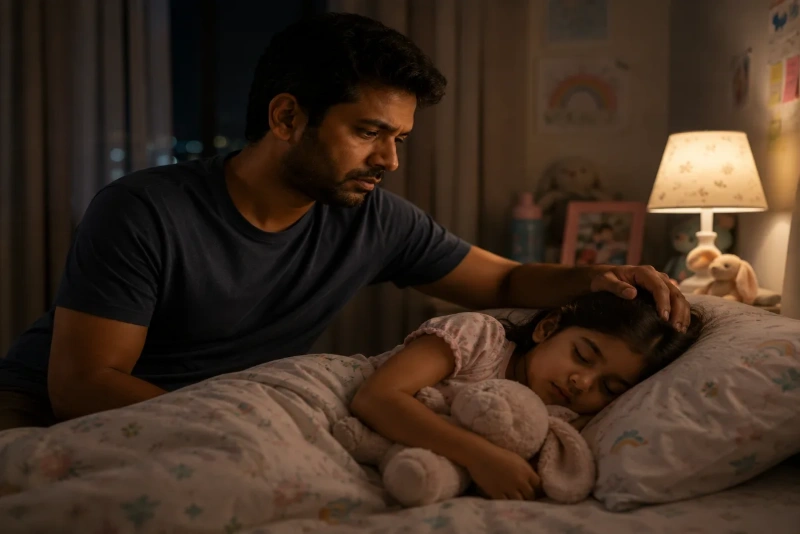
Raghav had given that company ten years. Not the kind of ten years you list on a resume and move on from — the kind where you know which clients call on Monday mornings before the tea arrives, where your name is the one that gets mentioned when something critical needs to not go wrong. He was that person. So when he finally sat down to write his resignation letter, it wasn't a career decision. It was a father admitting he had run out of road.
His daughter Kavya was critically ill. The doctors had been careful with their language for weeks, but in the last conversation, they stopped being careful. Raghav had heard what they weren't saying as clearly as what they were. He didn't sleep that night. By morning, he had typed four lines and hit send before he could talk himself out of it.
Vineet Sharma, the founder, read the resignation on his phone. He read it twice. Then he called Raghav directly — not HR, not a manager, not an automated acknowledgement. Him.
"When Raghav finally spoke, his voice was barely holding together. 'My daughter needs me more than anything else right now. I cannot give even a part of my attention to work.'"
The Part Nobody Prepares You For
There's a version of this story that plays out every day across offices in India. An employee faces a family crisis too severe to work through. They write a resignation because they don't see another option — because the system has never shown them one. HR processes it. The notice period is negotiated. Someone else picks up the work. The person disappears from the team's memory within a quarter.
Vineet asked if Raghav could work from home, even part-time — not because the company needed it, but because he was searching for a way to keep Raghav's income intact without making it feel like charity. Raghav said no. Quietly, without explanation, but with the kind of finality that only comes from sitting in a hospital corridor for days straight. He needed to be completely present. The laptop staying home wasn't enough. He needed to not be an employee for a while.
That's when Vineet said something that Raghav did not expect to hear from anyone, least of all an employer.
What Was Said — and What Actually Happened
What "Don't Worry About Money" Actually Costs
It is easy to say those four words. It is considerably harder to mean them in writing, month after month, with no timeline attached. Vineet didn't offer a week of paid leave or a one-time gesture. He offered Raghav's salary continued indefinitely, with no expectation of return until Raghav himself decided he was ready.
For a middle-class professional in India, the financial architecture of a family crisis is brutal. Medical bills don't pause because you're emotionally overwhelmed. EMIs don't pause. School fees don't pause. The terror of losing your income on top of potentially losing your child is a weight that crushes people — not occasionally, but routinely. Vineet removed that weight from one family's equation. Quietly, without a press release.
Vineet didn't create a policy or announce a programme. He made a single decision about a single person — someone he knew, whose ten years of work he had watched up close. It didn't require a committee or an HR framework. It required him to decide that Raghav's dignity mattered more than an open position on an org chart.
When the story made its way onto X, people weren't sharing it because it was inspirational content. They were sharing it because it was unfamiliar — the feeling of reading about something you didn't know was possible until you saw it written down.
Two Ways of Seeing the Same Situation
The People Who Were Watching
Something happened inside that company after Vineet's decision became known internally. No memo was sent. No all-hands was scheduled. But Raghav's colleagues found out — the way these things always find out — and the office quietly absorbed what it meant. Several team members volunteered to cover Raghav's work without being asked. Not because they were told to. Because they had just watched their employer treat someone with a kind of dignity they hadn't seen before, and they wanted to be part of it.
This is something that doesn't show up in engagement surveys or retention metrics, but it is perhaps the most real thing that happened in that company that month. People work differently when they believe the organisation they're part of would not abandon them at the worst possible moment. Not harder, necessarily — differently. With less of their energy spent managing their own anxiety about what would happen to them if things went wrong.
How People Responded When This Went Public
Raghav is still away from the office. The ledgers are being managed. The business is continuing. Nothing that Vineet did created operational chaos, which is worth noting — because the fear that doing the right thing will break something is usually what stops people from doing it.
Kavya's condition remains serious. There are no clean endings here, no resolution to offer. What exists is a father who is present — fully, without distraction, without the background terror of a family's finances collapsing around a hospital bed — because his employer made one decision and stuck to it.
"Most of us won't ever need to make the choice Vineet made. But we will all, at some point, be in a position where the system gives us a reason to do less than we know is right. What we do in that moment is the only measure of leadership that actually matters."